

We Buy Used Chillers & Cooling Equipment
Surplus Buyers & Demo buys used chillers and industrial cooling equipment from plants, hospitals, campuses, cold-storage facilities, and data centers nationwide. Cooling equipment is heavy, expensive to move, and easy to undervalue — which is why so much of it gets scrapped out of buildings whose owners never learned what it was worth as working equipment. A chiller that still cools, a tower that still runs, and a dry cooler that never even got installed all have buyers. We price cooling equipment as equipment, in writing, from the nameplate and its history. We are based in Houston, Texas and buy nationwide.
What We Buy
- Air-cooled chillers — packaged outdoor units in the commercial and industrial tonnage range.
- Water-cooled chillers — centrifugal, screw, and scroll machines from central plants.
- Cooling towers — field-erected and packaged towers, including the dry coolers and condensers used in data-center cooling.
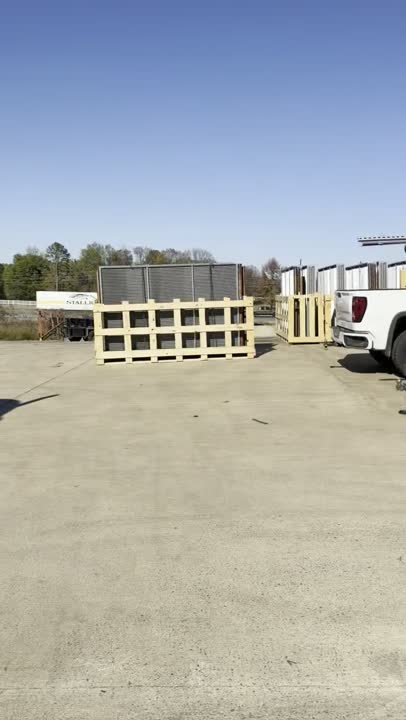
- Dry coolers, fluid coolers, and condensers — including crated, never-installed units from cancelled projects.
- Supporting equipment: chilled-water and condenser-water pumps, air handlers, and the motors and drives that run them, when they are part of the same cleanout.
- Brands we buy: Trane, Carrier, York (Johnson Controls), Daikin / McQuay, and other established industrial lines.
- Conditions: in service, decommissioned in place, removed and warehoused, failed compressors (priced accordingly), and new surplus that was delivered and never installed.
What Sets the Price
- Tonnage and type. Capacity sets the market, and common tonnage ranges in standard configurations fit the most facilities. Air-cooled and water-cooled machines sell into different pools, and each prices on its own demand.
- Age, hours, and history. A chiller retired in a planned plant upgrade, with service records, is a working asset. Run history and maintenance paperwork tell the next owner the machine was cared for, and cared-for machines get priced with confidence.
- Compressor and refrigerant. Compressor type and condition are the heart of a chiller's value — a machine with a failed compressor prices on its remaining equipment and material value, not as a running chiller. Refrigerant type matters too: machines on current refrigerants fit more buyers than machines on phased-out ones.
- Condition of the whole unit. Coil condition on air-cooled machines, tube and vessel condition on water-cooled ones, control panel intact, and whether the unit was holding charge and running when it came out of service.
- Never-installed surplus. Crated equipment from cancelled projects is the strongest cooling surplus there is — it has no run hours at all. In November 2026 we bought a cancelled data-center project near Little Rock, Arkansas outright, including crated, never-installed cooling equipment that is headed back into service instead of into a scrap yard. Delivered does not mean depreciated.
- Removal and access. Cooling equipment is big and heavy, and rigging it out of a mechanical room, off a roof, or out of a plant costs real money. Straightforward access and ground-level units net stronger offers than the same machines in difficult locations — the equipment is identical, the cost of getting it out is not.
What to Photograph
- The chiller nameplate — tonnage, model, serial number, refrigerant, and electrical ratings. On large machines there may be separate compressor and unit plates; photograph both.
- The full unit from two sides, plus the control panel.
- Coils, fans, and condenser surfaces on air-cooled units and towers — condition here is visible and it is priced.
- Any leaks, corrosion, storm or freeze damage, shown honestly.
- Cooling towers and dry coolers: the full structure, fill and fan condition, and any crated or packaged units exactly as they sit.
- The setting — mechanical room, roof, or yard — and how a crane or forklift can reach the equipment.
How Selling It Works
Step 1 — Send photos of the nameplates and the equipment where it sits. Call or text (346) 733-1238, or use the quote form. Add any service records you have.
Step 2 — Get a written offer priced as working equipment — or, for failed machines, priced honestly on what remains.
Step 3 — Pickup is arranged, including the rigging and hauling heavy cooling equipment requires, coordinated with your schedule.
Step 4 — Payment on pickup, with a documented bill of sale.
Chillers Rarely Sell Alone
A central plant is a system: the chiller, the tower, the pumps, the air handlers, and the electrical gear feeding all of it — switchgear, MCCs, transformers, and often a standby generator. Priced piece by piece, each part waits for its own buyer. Priced as one cleanout, one written offer covers the room, one crew rigs it out, and the building is clear on your schedule. When you photograph a chiller, walk the plant: shoot the tower, the pump nameplates, and the electrical room too. Sellers are routinely surprised by which piece of a mechanical plant carried the most value — and it is not always the biggest one.
Cooling Towers Sell on Their Own Merits
Towers are often treated as part of the building and priced at nothing, but a sound packaged tower is a salable machine. What decides it is condition: the fill, the fan with its motor and gearbox, the basin, and the casing. Photograph the tower from the ground and, where it can be done safely, the fan deck and a look inside at the fill. Note whether it is counterflow or crossflow, and its capacity from the nameplate if one survives. A tower that served the chiller you are selling prices naturally alongside it; a tower standing alone still deserves its own photos and its own number.
Whether it is a single air-cooled chiller behind a warehouse or a full central plant coming out of a closing facility, start with the nameplate photos. Send them over and we will put a written number on the equipment.
Frequently Asked Questions
My chiller has a failed compressor. Is it worth anything?
Possibly. It will not be priced as a running chiller, but the vessel, coils, controls, and material can still carry value depending on the machine. Send the nameplate and tell us the compressor's status.
Do you buy cooling towers and dry coolers, or only chillers?
All of it — packaged and field-erected towers, dry coolers, fluid coolers, and condensers, including crated never-installed units from cancelled projects.
The chiller is on a roof / in a basement mechanical room. Can you still buy it?
Yes. Difficult locations are a rigging question, not a disqualification — they do factor into the offer, because removal cost is real. Photograph the setting and the access route so the number is accurate.
What about the refrigerant in the unit?
Leave the machine as it sits; do not vent or drain anything. Note the refrigerant type from the nameplate when you send photos — it is part of how the unit is priced and handled.
Can you buy the whole mechanical plant, not just the chiller?
Yes — that is often the best way to sell it. Chiller, tower, pumps, and the electrical gear feeding them can be priced as one lot with one pickup. Photograph the whole room.
How am I paid?
Payment on pickup, with a documented bill of sale. Larger projects can be set on agreed written terms before removal starts.
Send photos of the nameplate and the gear — call or text (346) 733-1238 for a written offer.
Office: (346) 526-1405 · Toll-free: 1 (877) 722-6048
Tell Us What You Have →