

How to Sell Your Used Electric Motors
Every plant has them: motors on a spare rack, motors still bolted to pumps that stopped running years ago, motors in a corner of the motor room that nobody wants to be the one to throw away. Selling them is not complicated — but it is a process, and most of the money sellers lose on used motors is lost in the handling, not the haggling: leads cut for no reason, good motors buried in a pile with burned ones, whole lineups scrapped before anyone priced them. This guide walks through the selling process step by step, from identifying what you have to getting paid at pickup. For what drives the price itself — horsepower, frame, voltage, enclosure, brand — see our companion guide, What Is a Used Industrial Motor Worth? This one is about how to sell.
Step 1 — Identify What You Have
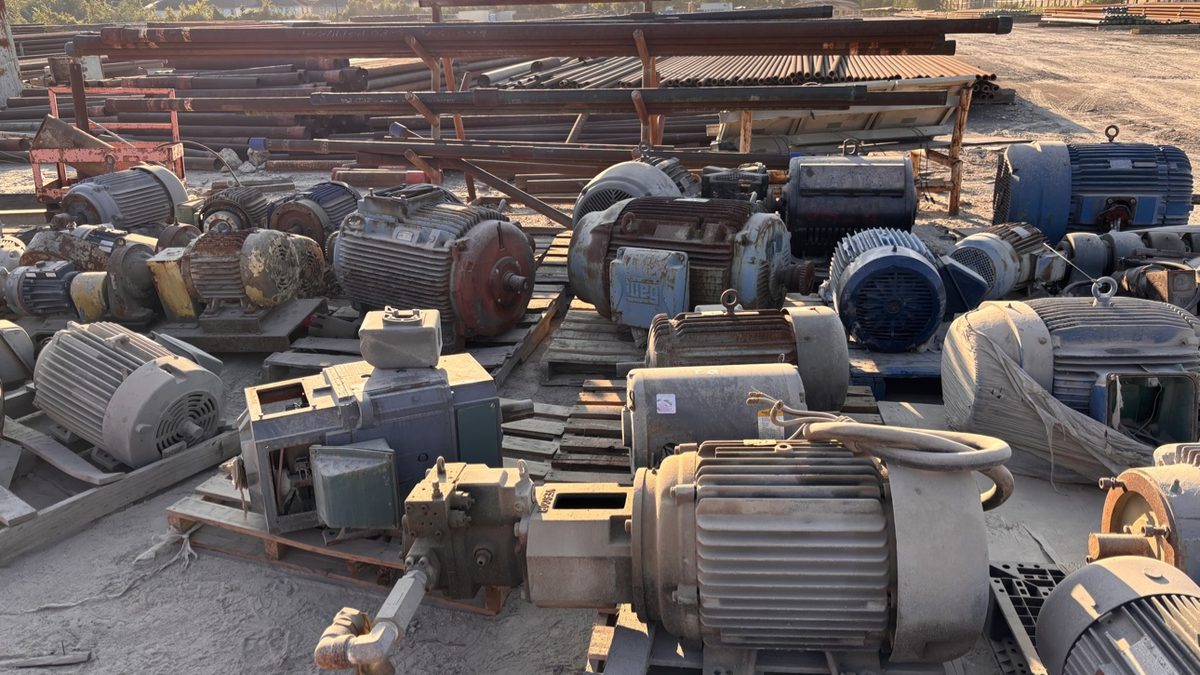
Start with a walk-through. Motors hide in more places than sellers expect: the motor room, a mezzanine spare rack, the maintenance shop, a warehouse crate — and still mounted on the pumps, fans, and compressors they drove, including equipment that has been out of service for years. You do not need a spreadsheet or an inventory system. For each distinct motor, the nameplate tells the story: manufacturer, horsepower, frame size, voltage, RPM, and enclosure. Where several motors are identical — common with shelf spares — one nameplate represents the whole stack; just note the count. A motor with a missing or unreadable nameplate can still be sold, but it will be priced as unidentified, so every plate you can read is worth reading.
Step 2 — Photograph the Nameplates First
Buyers price motors from photos, and the nameplate photo does most of the work. Wipe the dust off, get the plate square and legible, and take one close-up per distinct motor. Add a wide shot of each group so the buyer can see quantities and how the motors are stored, and a shot of anything unusual — a gearbox attached, a brake, a special mount. The motors do not need to be moved, cleaned up, or staged; photographs of them exactly where they sit are what an honest offer is built on. A blurry nameplate does not stop an offer, but it does make it conservative, because the buyer is pricing what he cannot confirm.
Step 3 — Sort Runners From Cores, Honestly
Before you ask for a price, sort your motors into honest groups — at least in your notes, even if they never move an inch:
- Running take-outs — removed while working, during an upgrade, a line change, or a shutdown. These are the strongest used motors there are.
- Shelf spares — kept as backups, never or rarely run. Say if they were stored indoors and how they were kept.
- Untested and unknown — history nobody remembers. There is no shame in this pile; most motor rooms have one.
- Failed motors and cores — burned windings, seized shafts, damaged housings. These sell on core and material value, not as working motors.
Sorting matters because of how buyers think. A mixed pallet gets priced as if the worst motor in it is typical — the good ones end up subsidizing the bad. Sorted groups get priced on what they actually are, group by group. And hiding a burned motor in the middle of a load never works: it is found at pickup, and then the whole offer is back on the table instead of just that motor. Honest sorting is what keeps a written offer firm all the way to payment.
Step 4 — Decide the Shape of the Sale
One large motor can justify a sale by itself. Small motors almost always move better as a lot — gathered together, they are worth a buyer's trip in a way that two or three scattered singles are not. Motors still mounted on pumps, fans, or compressors can sell as packages with the equipment they drove, which sometimes prices better than the motor alone. And motors rarely live alone: the same cleanout often includes MCC buckets, breakers, starters, or a transformer. Priced as one combined lot with one pickup, that package usually earns a better total than dribbling the pieces out one at a time — and the room is clear in a day instead of a season.
Step 5 — The Offer, the Pickup, and the Payment
Send the photos. Nameplate close-ups, group shots, your honest notes on which motors ran and which failed, and a word about access — where the motors sit and what can reach them.
Get a written offer. We price the lot in writing, group by group: equipment money for the motors that earn it, fair core and material value for the ones that do not. Compare it against any by-the-pound scrap quote; for identified motors in decent shape, the equipment offer should win clearly.
Pickup and removal are arranged. Motors still mounted or wired are fine — disconnection, rigging, and loading are handled as part of pickup on larger lots, coordinated with your schedule and your lockout procedures.
Payment on pickup. You are paid when the motors are picked up, with a documented bill of sale. Nothing leaves on a promise.
Decommissioned and As-Removed Motors
A large share of the motors we buy are decommissioned — pulled during plant closures, line removals, and demolitions — and as-removed condition is normal in this market, not a problem to apologize for. Two things protect your money on a closure. First, timing: call before the demolition crew starts, not during it. Motors that get knocked loose, dragged, and rained on lose value fast, and once a building is a job site, your schedule belongs to the demo contractor. Second, storage: keep removed motors indoors or under cover, do not cut the leads to make them easier to carry, do not pressure-wash them, and keep the nameplates readable. A decommissioned motor stored dry with its leads intact is a sellable asset; the same motor weathered in a laydown yard is on its way to core value.
Mistakes That Cost Sellers Money
- Cutting leads short. It saves nobody any real effort and shaves value off every motor it is done to.
- Mixing failed motors in with runners. The whole lot gets priced like the worst of it — or repriced at the truck when the truth comes out.
- Storing removed motors outdoors. A few months of weather turns clean take-outs into a corrosion discount.
- Waiting until demolition week to call. When the demo schedule is the deadline, sellers take whatever is offered. A few weeks of lead time gets real offers.
Surplus Buyers & Demo is based in Houston and buys used electric motors in every state in the continental US — our electric motor buyer pages cover all 48 states — from a single large motor to full motor-room cleanouts on plant closures. Send the nameplate photos, tell us honestly what ran and what did not, and we will take it from there.
Frequently Asked Questions
Do the motors need to be removed or disconnected before I sell them?
No. Motors still mounted, still wired, or sitting in a motor room can all be priced from nameplate photos. On larger lots, disconnection, rigging, and loading are arranged as part of pickup, coordinated with your lockout procedures.
Should I separate the running motors from the burned-out ones?
Yes — at least in your notes, and tell us which are which. Sorted groups get priced on what they actually are. A mixed lot gets priced as if the worst motor is typical, and a failed motor hidden in a load only gets the whole offer revisited at pickup.
I only have one or two motors. Is that enough?
It can be. A single large motor often justifies a sale on its own. Small motors do better gathered into a lot, or combined with other electrical surplus — breakers, starters, MCC buckets — in one pickup.
Can you buy motors out of a plant that is closing or being demolished?
Yes — decommissioned and as-removed motors are a large part of what we buy. Call before demolition starts if you can; motors priced and scheduled ahead of the demo keep their value, and pickup is coordinated with your shutdown.
How fast can I get an offer?
With clear nameplate photos and honest notes on condition, we can usually turn a written offer quickly — the photos are what make it fast. Text them to (346) 733-1238.
How am I paid?
Payment on pickup, with a documented bill of sale. Larger projects can be set on agreed written terms before removal starts.
Send photos of the nameplate and the gear — call or text (346) 733-1238 for a written offer.
Office: (346) 526-1405 · Toll-free: 1 (877) 722-6048
Tell Us What You Have →