

What Is a Used Industrial Motor Worth?
Industrial motors are where sellers most often leave money on the table — in both directions. Small motors get hauled across town chasing equipment prices they will never bring, while large premium motors get sold by the pound for a fraction of their working value. The truth is that a used motor's worth follows a handful of readable factors, and almost all of them are printed on the nameplate. This guide covers those factors, explains where the line between equipment value and scrap value really sits, and shows you how to get a number you can trust.
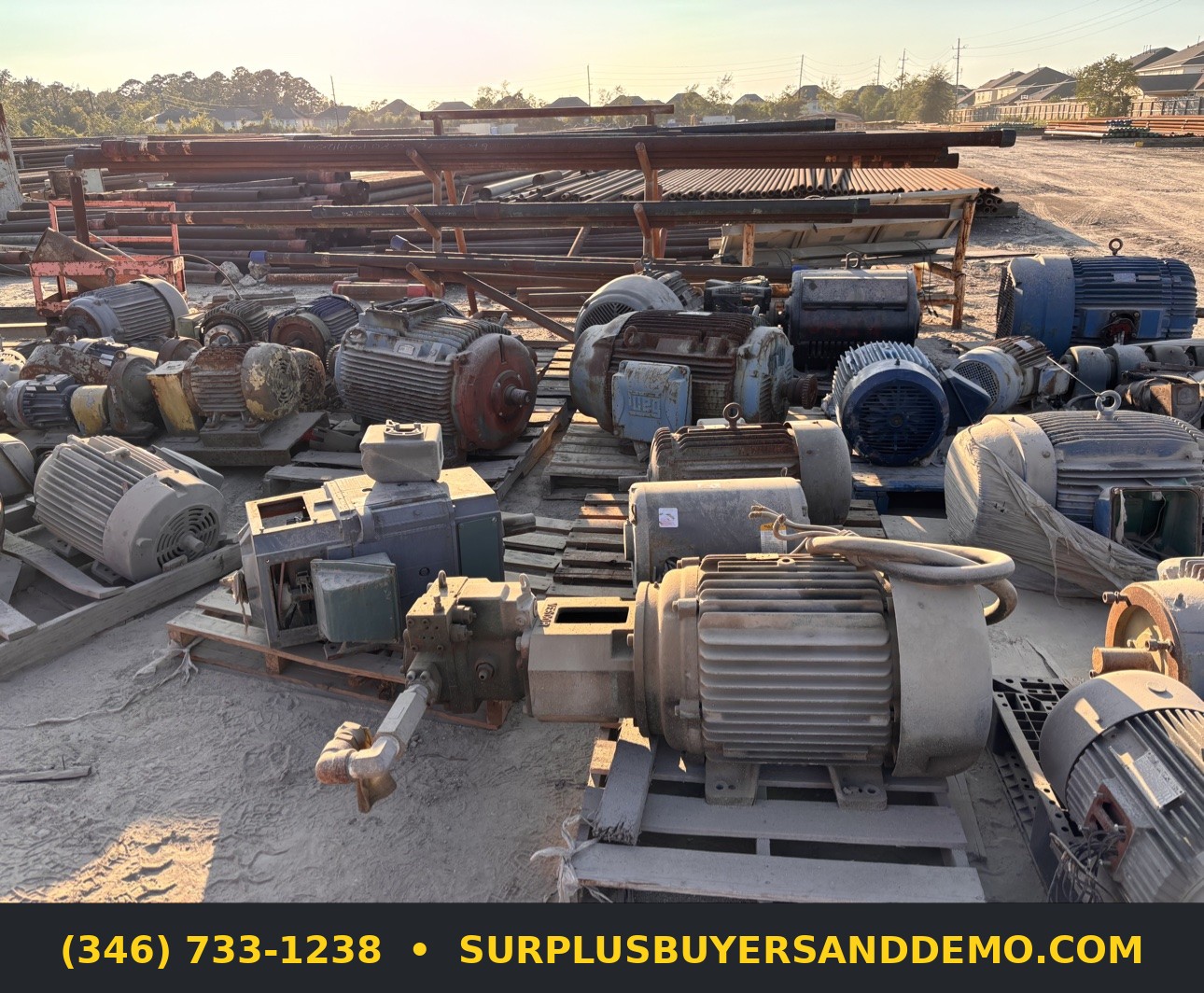
Factor 1: Horsepower — the Biggest Lever
Motor value climbs steeply with horsepower. Fractional and small integral-horsepower motors are commodities: they are cheap new, everywhere used, and their value sits close to their material content. As horsepower rises, the picture changes — large motors cost serious money new, take time to source, and are exactly what a plant with a failed motor needs today, not in a factory lead time. That urgency is what you are selling. As a rough orientation only: the bigger the motor, the more it pays to get an equipment quote before a scrap quote, because the gap between the two widens with size.
Factor 2: The Nameplate Details
- Frame size — tells a buyer the motor's physical class and mounting. Large frames (and older U-frame motors, which have a loyal following) price differently from standard T-frames.
- Voltage — 460V is the industrial standard and has the deepest market. Dual-voltage 230/460V motors fit more buyers. Odd voltages and 575V motors serve narrower markets and price accordingly.
- RPM — standard speeds (3600, 1800, 1200) move fastest; unusual speeds have fewer homes.
- Enclosure — TEFC (totally enclosed fan cooled) motors fit more environments than open drip-proof (ODP) motors and generally hold value better. Explosion-proof and severe-duty enclosures serve specific industries and can carry a premium there.
- Efficiency — NEMA Premium and inverter-duty (inverter-rated) motors are what plants are buying now, and they hold used value better than older standard-efficiency units.
Factor 3: Brand
Installed base drives demand. Baldor-Reliance, WEG, Toshiba, Marathon, Leeson, Siemens, and ABB motors have deep resale markets because so many plants run them and stock spares to match. Lesser-known and imported brands are not worthless, but they price lower because the buyer pool is thinner. The brand is right there on the nameplate — another reason that one photo does most of the work.
Factor 4: Condition — Running Take-Out vs. Burned Out
A motor removed while running, during an upgrade or a line change, is the strongest used motor there is. A motor that failed is a different asset: burned windings mean the next owner faces a rewind bill, so a failed large motor is usually priced on its core and material value rather than as a working motor. Either way, disclose what you know. Details that matter and are easy to check: does the shaft turn freely by hand, is the conduit box intact, are the leads cut short or full length, is there visible damage to the fan cover or feet? Cut leads and broken feet are small things that shave real money, because they add labor to every next step.
Special Motors Are Worth a Second Look
Before any motor goes to scrap, check whether it is something special: DC motors, wound-rotor motors, gear motors, brake motors, explosion-proof motors, and large vertical hollow-shaft pump motors all serve narrower but motivated markets. So do matched spares — a motor that is the exact spare for a running line is worth more to that plant than its generic twin. If the nameplate shows something you do not recognize, that is exactly the one to photograph.
Factor 5: Quantity and Matched Sets
One motor is a transaction; a matched set is an asset. Plants standardize on a motor across a line, and when they stock spares they want the exact same motor — same horsepower, frame, and speed. If your cleanout includes several identical motors, especially identical shelf spares, say so and photograph one nameplate with the count. Matching motors are worth more per unit than the same motors scattered as singles, because a buyer can place a set with one facility instead of hunting homes for each one. The same logic applies to motors still mounted on the equipment they drove — pumps, fans, and compressors being sold as packages. If the driven equipment is being sold too, mention it; a motor and its machine sometimes price better together than apart.
Removal: Who Disconnects, Who Lifts
Sellers often ask whether motors need to be off the floor before they can be sold. They do not. Motors still mounted, still wired, or sitting in a motor room can all be priced from nameplate photos. On larger lots, disconnection, rigging, and loading are arranged as part of the pickup — your crew's time is worth money too, and a buyer who handles removal is saving you real labor. What does help is access: a motor a forklift can reach loads cheaper than one that has to be craned out of a pit, and honest notes about access keep the written offer firm instead of adjusted on the day.
How to Get a Real Number
Step 1 — Photograph the nameplate of each distinct motor, plus one wide shot of the group. Note quantities of identical motors — a stack of matching spares is worth more per motor than singles.
Step 2 — Note the history if you know it: running take-out, spare on a shelf, or failed and pulled.
Step 3 — Get a written offer. We sort your lot honestly — equipment money for the motors that earn it, fair material value for the ones that do not — in one number.
Step 4 — Pickup arranged, payment on pickup, with a documented bill of sale.
Surplus Buyers & Demo buys industrial motors nationwide from Houston — singles, matched sets, and full motor-room cleanouts, running or not. Send the nameplate photos and we will tell you which of your motors are worth equipment money and why.
Frequently Asked Questions
Is a burned-out motor worth anything?
Yes, usually — a large failed motor carries core and material value even when it no longer runs. It will not be priced as a working motor, but it should still beat tossing it in with light scrap. Send the nameplate.
My motors are small — a few horsepower each. Worth calling?
Small motors price close to their material value, but in quantity they add up, and if they are part of a larger electrical lot we price everything together. Send one group photo and a count.
Does the motor need to be tested?
No. We buy running take-outs, shelf spares, untested motors, and failed motors. History and condition shape the offer; testing is not required to get one.
Why does voltage matter so much?
Because a motor only fits a facility wired for it. Standard 460V and dual-voltage motors have the most potential buyers, and more buyers means a stronger price.
Should I cut the cables off before you pick up?
No — leave leads full length and the conduit box intact. Cut leads lower a motor's value. We handle disconnection and removal as part of pickup on larger lots.
How am I paid?
Payment on pickup with a documented bill of sale. Larger projects can be set on agreed written terms.
Send photos of the nameplate and the gear — call or text (346) 733-1238 for a written offer.
Office: (346) 526-1405 · Toll-free: 1 (877) 722-6048
Tell Us What You Have →